
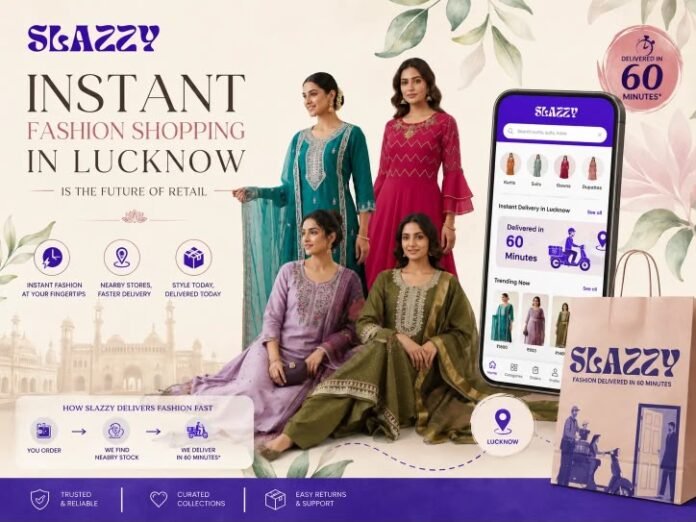
Slazzy, founded by Shubham Gopal and Mansi Bajpai, is redefining how consumers shop for fashion by bringing hyperlocal, technology-driven, 60-minute fashion delivery to Indian cities. Built on the belief that fashion should be as accessible and instant as food or groceries, the startup is creating a new category in Indian e-commerce by connecting local fashion retailers directly with nearby customers.
The Founders Behind Slazzy
At the helm of Slazzy is Shubham Gopal, Founder & CEO, who brings over seven years of experience in software development and e-commerce technology. Prior to launching Slazzy, he worked as a Senior Technical Consultant at EY (Ernst & Young), where he helped numerous businesses build and scale technology solutions.
Through his experience working with e-commerce brands, Shubham identified a recurring challenge: customers often needed clothing urgently, yet traditional fashion platforms required several days for delivery. Simultaneously, local retailers possessed ready inventory but lacked digital visibility. This gap became the foundation upon which Slazzy was built.
Joining him is Mansi Bajpai, Co-Founder and Head of Operations & Growth. With more than six years of experience across companies such as Zomato, OYO, and Paytm, Mansi brings expertise in operations, merchant management, growth strategies, and city-level execution. Her experience scaling large operational ecosystems has played a crucial role in building Slazzy’s hyperlocal commerce model.
Solving a Real Consumer Problem
The idea behind Slazzy emerged from everyday situations faced by millions of consumers.
Whether it’s an unexpected party invitation, a last-minute wedding function, an important office meeting, a job interview, or a special date night, people frequently need clothing on short notice.
While food can arrive within minutes and groceries within hours, fashion remains one of the slowest categories in e-commerce.
Recognizing this gap, the founders envisioned a platform that could bring fashion delivery into the era of instant commerce.
Why Slazzy Chose Hyperlocal Instead of Dark Stores
Unlike grocery quick-commerce platforms that rely heavily on dark stores, Slazzy adopted a different approach.
Fashion inventory is inherently complex, involving multiple sizes, colors, styles, and constantly evolving trends. Maintaining such inventory in dedicated warehouses would require significant capital while creating substantial inventory risk.
Instead, Slazzy leverages inventory already available in local retail stores.
The company’s hyperlocal model enables greater variety, better unit economics, faster scalability, reduced inventory risk, and stronger support for local retailers.
Rather than competing with neighborhood fashion stores, Slazzy empowers them through technology.
How Slazzy Works
The platform operates through a simple but powerful process.
Customers browse fashion products on the Slazzy app and place an order. Nearby partner retailers receive the request, inventory is allocated from the most suitable store, and delivery partners pick up and transport the product directly to the customer.
The result is fashion delivered in approximately 60 minutes.
This creates value for all stakeholders:
- Customers receive products quickly.
- Retailers generate additional sales.
- Cities benefit from a digitally connected retail ecosystem.
What Makes Slazzy Different
Most traditional fashion marketplaces focus on centralized warehouses and nationwide inventory networks.
Slazzy takes the opposite approach.
Its model is built around local inventory, hyperlocal fulfillment, retailer partnerships, and an asset-light operating structure. While conventional fashion platforms typically deliver products in days, Slazzy aims to deliver them within an hour.
The company believes that the infrastructure required for rapid fashion commerce already exists. Retail stores, inventory, and delivery networks are already in place. The missing component is technology that can connect them efficiently.
Starting Smart with Lucknow
While many startups begin their journey in major metropolitan markets such as Delhi, Mumbai, or Bengaluru, Slazzy intentionally chose Lucknow as its launch city.
According to the founders, Lucknow offered lower operational costs, easier retailer onboarding, reduced traffic congestion, and greater control over customer experience. More importantly, it provided an ideal environment to test, validate, and refine the hyperlocal fashion commerce model before expanding to larger markets.
The strategy allowed the company to optimize operations and understand customer behavior without incurring the high costs often associated with larger cities.
The Vision Ahead
Slazzy’s long-term goal is to become India’s largest hyperlocal fashion commerce network.
Having established its foundation in Lucknow, the company is now preparing for expansion into Delhi NCR and other major markets. The founders envision a future where thousands of fashion retailers and millions of consumers are connected through a fast, local, and technology-driven ecosystem.
As consumer expectations continue to evolve toward convenience and instant fulfillment, Slazzy believes fashion is the next major category poised for disruption.
With a scalable model, retailer-first approach, and focus on hyperlocal delivery, the startup is positioning itself to lead the future of fashion commerce in India.
Download Slazzy:
Google Play Store: https://play.google.com/store/apps/details?id=com.slazzy&pcampaignid=web_share
Apple App Store: https://apps.apple.com/in/app/slazzy/id6762513597


